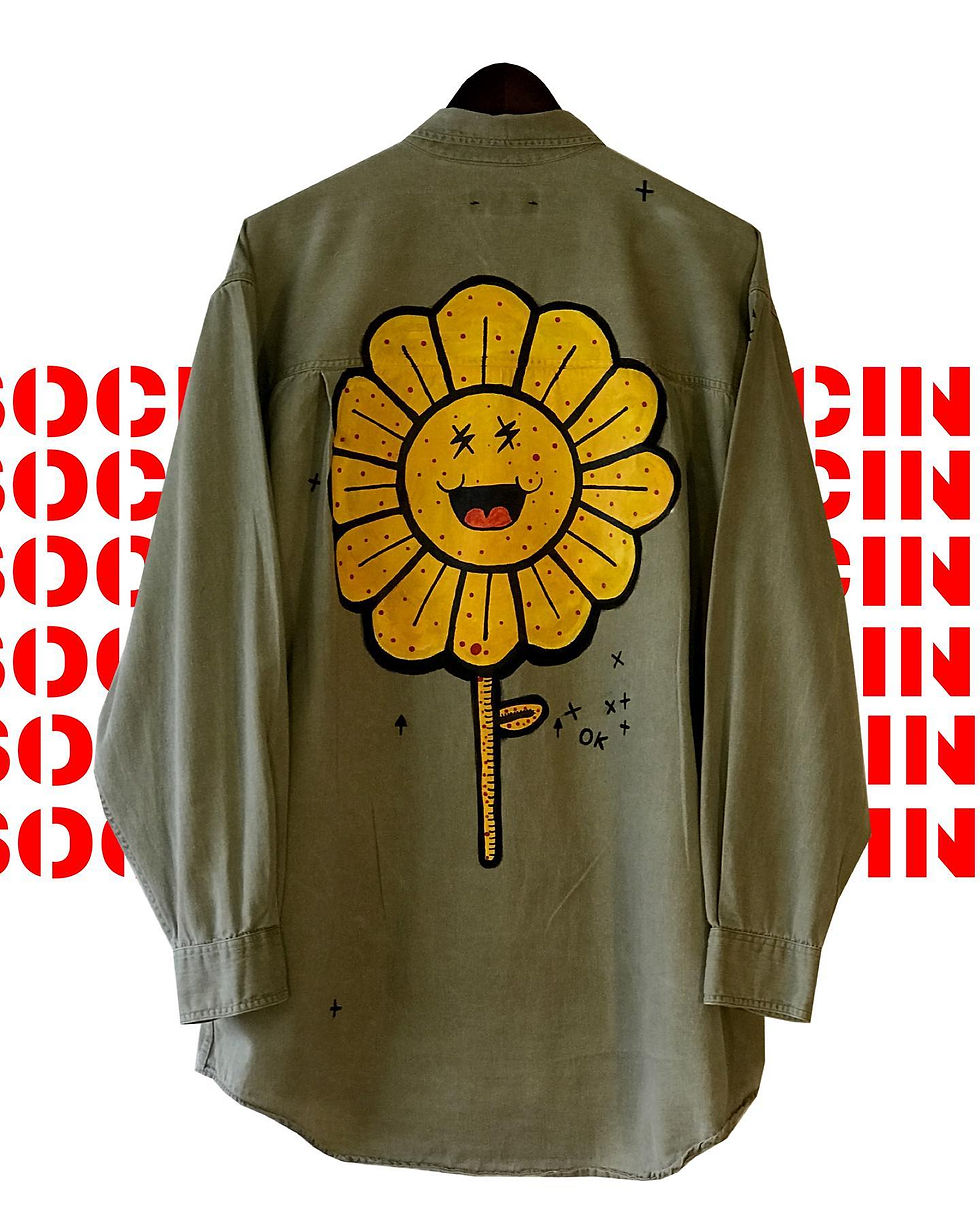
The Sick
Flower
2019 - 2021

Confinement, the Collapse of Truth, and the Image as Survival
THE SICK FLOWER marks one of the most conceptually dense and existentially charged thresholds in my practice, precisely because—at the level of sheer survival—concepts begin to blur. Suspicion, which had previously functioned as a critical method, mutates here into a lived condition: a state of trance, of connection and disconnection, a route back toward oneself—or a drift into loss. The series is inseparable from the historical rupture that produces it (the COVID-19 pandemic), yet it matters not only as “context” but as an event that forces three lines of inquiry—previously articulated with relative separation—to collapse into one field of experience: territory, the truth-status of the image, and the forms of sensitivity, perception, and subjectivity in contemporary life.
The pandemic operates in this work as an event of almost wartime scale. In the United States, by mid-2021, COVID-19 deaths surpassed the total number of American soldiers killed in World War II; and in cities such as New York, mortality rates in 2020 approached—and in certain measures exceeded—the figures associated with the 1918 influenza. Within this historical intensity, the crisis of the document that runs through my earlier projects (ethics of the portrayed subject, institutional narration, landscape as proof, the archive, intimacy, the credibility of images) ceases to be primarily a problem of representation. In THE SICK FLOWER, it becomes a total experience of the body trapped inside a global historical fiction, where truth no longer stabilizes reality but increasingly resembles a contested narrative produced at the scale of infrastructure.


New York as the Threshold Between
Two Regimes of World
My displacement to New York in November 2019 marks a precise threshold between two regimes: the late-capitalist horizon of acceleration and mobility, and the sudden ontological suspension imposed by global lockdown. The migration that brings me to the United States is not romantic; it is structurally entangled with globalization and capital. I spend three months moving through the country with a clear objective: to open market routes for Goodarma, the family clothing brand for which I was responsible. Miami, New York, Los Angeles—this itinerary traced a familiar capitalist promise: that work, desire, and imagination might translate into upward movement. In the middle of that trajectory, the pandemic arrives without warning. At first it appears as a distant disturbance, but it quickly colonizes every screen, every conversation, every daily decision—until it becomes the primary medium through which reality is perceived.
New York initially registers for me as a city of acceleration: hypercosmopolitan energy, symbolic density, cultural and economic vitality—an organism that once again offers itself as a machine of visibility. I remember the sensation of entering a kind of future-engine. Then the same organism enters paralysis. Airports close, borders harden, mobility is interrupted, and I remain trapped inside the United States with no immediate possibility of return. The pandemic does not simply stop the city; it suspends it ontologically. Time no longer advances toward a recognizable destination. It becomes a frozen present in which the only stable narrative is the daily count of deaths.
Counting, Militarization, and the Conversion of Death into Data
The social rupture becomes the true sensitive core of this new reality. Suspicion—already a recurrent axis in my work—intensifies to the point where truth paradoxically begins to behave like fiction. The subway empties. Distancing becomes a new choreography. Manhattan militarizes. On public television, the brutal murder of George Floyd repeats relentlessly. Hospitals collapse. Public space deactivates while death turns into a statistic. Time reorganizes into curves, peaks, waves, charts. Daily life becomes governed by counting: infections, ICU beds, bodies accumulating in refrigerated trucks. The historical atmosphere—comparable to a world war but without visible fronts—settles into silence, into emptied streets, into fear embedded in ordinary gestures.
Bushwick, Brooklyn becomes the epicenter of a radical confinement experience. I am welcomed into a shared home—“Las Chicas”—a warm and fraternal space led by women artists working from a conceptual feminist orientation. That communal and affective dialogue becomes crucial to my understanding of how structural violence traverses the migrant body. In kitchens and living rooms, through shared insomnia, we talk about race, class, gender, precarity, art, and the problem of maintaining dignity inside collapse. At the same time, the loss of external physical bonds, the death of my father in Colombia without the possibility of returning, the interruption of work, scarcity, isolation, and media saturation produce a scenario that no longer resembles “normal life.” A city once built for circulation becomes a device of enclosure; reality gradually acquires the texture of dystopia—an endless tape with no horizon, where counting becomes the dominant grammar of the present.

Urban Resistance and Mutual Aid
Parallel to fear, New York also enters a cycle of urban resistance that cuts directly through lived experience. Tenant movements call for mass rent strikes, demanding eviction suspensions and asserting housing as a right rather than a speculative privilege. The spring 2020 rent strike—driven by tenant alliances and housing justice organizations—articulates a collective response to the impossibility of paying rent in a world that has stopped. From Las Chicas, we participate in these discussions, mutual aid networks, and collective strategies of survival: if the system abandons us, we do not abandon each other. At least one major press article registers these domestic resistances—shared cooking, pooled rent, care practices—as part of a broader cartography of mutual aid. Here, everyday survival becomes political form.
Necropolitics, Differential Exposure, and Racialized Mortality
This extreme event confirms an intuition already present in my earlier work: a society is capable of sacrificing parts of itself when the economy enters panic. The pandemic becomes a laboratory of biopolitics and necropolitics, in the sense articulated by Achille Mbembe: sovereignty as the power to decide who may live, who must die, and who is differentially exposed to precarity and disappearance. Under an extended regime of exception, certain lives appear protected—insured, confined in larger spaces, able to telework, able to isolate—while others are treated as expendable, forced into daily exposure through “essential” labor, crowded transit systems, and neighborhoods with collapsing health infrastructures. This is not metaphor. It is the administration of life and death as routine governance.
In New York, the brutality of this inequality becomes visible. Municipal reports and national studies show that from the earliest months of the pandemic, Black, Latino, and Indigenous populations die from COVID-19 at rates close to—and at certain moments exceeding—double those recorded in white populations. These figures are not abstract numbers; they are statistical cartographies of a death policy distributed through race and class. Death stops being intimate event and becomes administrative operation: a cell in a hospital spreadsheet, a line in an epidemiological report, a point on a heat map concentrating damage in the same territories and bodies historically rendered vulnerable.

The Virus, Suspicion, and the Acceleration of Technological Regimes
The figure of the virus returns as a figure of the carrier, of suspicion. A paradoxical and macabre script installs new forms of segregation—no longer only racial, but tied to economic access, the capacity to demonstrate immunity, the possibility of isolating, the possession of technology that allows one to remain “productive” at home. The other body, the surface, the everyday object—everything becomes a potential vector. Speculation proliferates: Who has the virus? Does matter transmit it? Is the virus real, or a control device? At the same time, hyper-acceleration receives both its wound and its ultimate boost: the world leaps into intensified digitalization—telework, algorithmic traceability, sanitary surveillance, and massive information circulation. Two narratives develop in parallel: those who successfully enter this new order (broadband, telepresence, livable space), and those who remain outside, surviving at the front line of risk. Under these conditions, counter-archives, photography, and art become instruments of memory and resistance—ways of stating: we were here; this happened to us—inside a world that tends to erase or aestheticize suffering.
George Floyd, Protest, and the Domestic War-Zone
The health collapse is overlaid by the political and racial eruption following George Floyd’s murder. A city simultaneously confined and protesting enters historical combustion. This moment functions as a violent closure of one regime of experience and a forced jump into an intensified digital regime of control, representation, and symbolic dispute. I participate actively in marches: biking across the city, accompanying protests, documenting bodies, slogans, confrontations, occupied streets. The camera shifts from the classical reporter toward something closer to a war photographer in domestic territory.
The mass protests in New York are concrete: Black Lives Matter mobilizations, blockades, commercial buildings boarded with plywood, nights fractured by sirens and helicopters, the National Guard occupying emptied streets, broken windows, luxury incinerated. I recall witnessing the burning of the Dolce & Gabbana store; seeing clothes and shoes reduced to ash triggered an instinctive shift—luxury burning in an empty street condensed the collapse of aspirational desire and the emergence of another desire: justice. Often I cannot photograph what I see. More paradoxically: much of what occurs cannot be found later online as visible archive. Mediated history once again becomes subject to the interests of official archiving and its omissions. THE SICK FLOWER inserts itself precisely into those gaps—into what was not conveniently recorded, into the broken flower that refuses to disappear.
Post-Truth as Lived Condition
In this environment, truth as an epistemological category collapses. Post-truth stops being an abstract term and becomes lived experience: shifting numbers, corrected official versions, conspiracy theories spreading like parallel viruses, platforms saturated with incompatible discourses. Philosopher Lee McIntyre, in Post-Truth, describes this regime not merely as a time when truth “no longer matters,” but as a historical phase in which reality is deliberately manipulated, knowledge institutions are discredited, and affective narratives serving political interests are privileged. The pandemic becomes an extreme laboratory of this condition: epidemiological data competes with fake news; scientific reports compete with propaganda; images of hospital collapse compete with memes that deny tragedy.
The Sick Flower: Capital,
Ornament, Systemic Illness
It is here that THE SICK FLOWER begins to exist fully. The flower—nature’s emblem, but also capitalism’s ornament—appears sick. Historically, flowers have signified luxury, desire, and the appropriation of nature as commodity and distinction: floral motifs become brand patterns; visual culture converts vegetation into rentable décor. Within this logic, the sick flower is not simply a pictorial theme. It is the sign of systemic illness. What collapses is not only biological life but the relation to money, greed, and the expansive logic of capital, intensified by a quantum leap in technological acceleration. The pandemic, disguised as a health crisis, reveals itself as symptom of a structurally sick society—a diagnosis that resonates with thinkers like Byung-Chul Han, who reads exhaustion, self-exploitation, and burnout as preexisting pathologies preparing the ground for collapse.
Image as Orientation:
Photography, Painting, and the Body as Support
During this period, I move through the city mainly by bicycle—documenting marches, hospitals, shuttered facades, patrol cars, graffiti, and urban silences. Empty Manhattan avenues resemble science fiction sets, yet the distant ambulance sound and improvised thank-you signs in windows confirm it is not a film. I am an immigrant with no stable work, no money, no institutional support. How do you survive when the world collapses? The camera ceases to be an analytical instrument and becomes an existential compass. Photographing no longer means producing a historical archive in the classical sense; it means confirming that the world still exists and that my body remains minimally inscribed in its continuity. Each frame becomes a gesture of self-affirmation: I am still here; I am still seeing.
In parallel, I pivot decisively toward materiality. I begin producing garments—printing photographs onto shirts, intervening them, painting them, burning them. I carry a drawing notebook as a field diary: mutant flowers, fragmented bodies, masked faces, emptied streets. Scarcity and technical precariousness become secondary; what matters is sustaining a creative trance with whatever tools are available. The image leaves the wall and the screen to circulate on the body—becoming portable manifesto, surface of presence, and a mode of carrying the archive into public space when exhibition venues are closed. Clothing becomes a moving counter-archive.
Here my relationship to documentary photography is redefined. Years of critique of the document as persuasion apparatus, producer of pseudo-reality, and truth regime are not canceled—but temporarily suspended by a greater urgency: to bear witness in order not to disappear psychologically, and to build counter-histories against dominant narratives. THE SICK FLOWER acknowledges that photography no longer validates “the world” in abstraction; it validates the subject’s survival inside the world’s breakdown—and leaves behind an uncomfortable archive: images that do not soothe, but insist on memory.
Painting emerges simultaneously as internal resistance. Confined, I paint compulsively. Painting becomes refuge, a surface to drain anxiety, paranoia, fear, and impotence. These works are not romantic symbols but altered organisms: sick, mutant, hybrid vegetal bodies. The flower is not ornament; it is the figure of life under threat—city, migrant body, social body. Beauty crossed by decomposition; delicacy invaded by invisible toxins.
These flowers dialogue directly with Baudelaire’s Les Fleurs du mal. If in the nineteenth century the “flowers of evil” named a modern sensibility shaped by spleen, decadence, and the corruption of beauty under industrial capitalism, in THE SICK FLOWER that poetics returns embodied—inside pandemic toxicity: environmental, political, economic, and mediatic. The industrial city becomes the pandemic city: sirens, screens, algorithms, inequality—an intoxicated greenhouse for new flowers of the contemporary mal.